


A pair of federal immigration agents clad in camouflage and masks approached Ryan Ecklund’s car on a snowy Minnesota street last month with a stark warning.
“You will not be following us anymore,” one agent told him, “or you will be arrested.”
When Ecklund continued tailing the agents’ beige SUV and recording them, he quickly found his status as a US citizen didn’t protect him from being pulled from his car and handcuffed. The agents drove him to an Immigration and Customs Enforcement office in Minneapolis and checked him into detention at a table labeled with a handwritten sign: “USC 111.”


As Ecklund later learned, the sign was a reference to a once-obscure federal statute, 18 US Code 111, that has become a key tool used by immigration agents to detain American citizens. As residents have sought to protest and document arrests in Minneapolis, Chicago and other cities by blowing whistles, blocking streets and recording agents, immigration officers have increasingly responded by arresting people for “impeding” their operations – claiming that those actions violate the law.
A CNN review of federal court records found that the Trump administration has dramatically expanded the use of the statute. Federal prosecutors in areas that have seen intense protests – the four districts covering Minneapolis, Chicago, Los Angeles, and Portland – charged about 12 times as many people under the statute in the first year of the Trump administration as they did in the last year of the Biden administration.
But these charges have often fallen apart under scrutiny, CNN found.
In Minneapolis, dozens of people – including Ecklund – have been arrested and detained for hours but never charged, according to attorneys working on the cases and court files. Several of the cases filed in recent weeks have already been dropped by prosecutors or reduced from felonies to misdemeanors.
In Los Angeles, all five of the prosecutions under the statute that have gone to trial since last summer have resulted in an acquittal. Many cases that didn’t go to trial there and in Chicago have been dismissed, ended in a plea deal or only resulted in a civil citation with a fine, while others are still pending.
While some of those charged allegedly violated other parts of the law, such as assaulting officers or resisting arrest, many others arrested were accused only of impeding agents while protesting their operations, attorneys said.
Dozens of cellphone and body camera videos reviewed by CNN show that immigration agents are routinely threatening to arrest people who follow or film videos of them, sometimes specifically citing the statute.
That’s despite senior Trump administration officials, including acting ICE chief Todd Lyons, acknowledging to Congress last week that recording agents in public and yelling at officers does not violate federal law.

Legal experts say the court records and videos show that the administration is often abusing the law to target activities protected by the First Amendment, rather than using it to defend federal officers.
“When you exercise your First Amendment rights, that’s not impeding,” said Minnesota civil rights attorney James Cook. “It seems like their end game is just to arrest dissidents and people that generally disagree with the current administration.”
The Department of Homeland Security cited an increase in assaults on federal law enforcement officers to explain the rise in arrests and charges under the law.
“It should come as no surprise that there’s an increase in referrals under 18 U.S.C. 111 as there’s been a massive increase in violence and threats against federal law enforcement,” a DHS spokesperson said in a statement.
Neither DHS nor the Department of Justice commented on questions about the relative lack of convictions under the statute compared to the number of arrests.
“There are myriad factors that affect the outcome of any given prosecution — the fact remains that anyone who assaults one of our officers is committing a felony, and anyone who obstructs them is committing a federal crime,” the DHS spokesperson said.
A DOJ spokesperson added that the department “will continue to seek the most serious available charge against anyone who puts federal agents in harm’s way” and said, “those who attack law enforcement will be held fully accountable for their actions.”
ICE’s favorite law
As the Trump administration has ordered surges of immigration officers to major US cities, top officials have warned residents not to get in the way – or to risk arrest.
In a Fox News interview, Trump adviser Stephen Miller said his message to ICE agents was that “anybody who lays a hand on you or tries to stop you or tries to obstruct you is committing a felony.”
To carry out that message, immigration agents have increasingly turned to 18 US Code 111, which makes it illegal to “forcibly” assault, resist, oppose, impede, intimidate, or interfere with a federal officer performing their official duties. Convictions can carry up to eight years in prison, or 20 years if defendants used a “deadly or dangerous weapon” or inflicted “bodily injury.”
Prosecutors nationwide filed about 580 cases citing the statute during the first year of President Donald Trump’s second term, up about 40% from former President Joe Biden’s last year in office, according to data downloaded from the search platform CourtLink.
The rise has been especially stark in cities that have been roiled by enforcement surges and protests. In Minnesota, federal prosecutors have filed 35 cases in December and January, compared to just nine during Biden’s entire four-year term.
Those charges appear to represent just a fraction of the number of arrests in Minnesota under the law. While there are no publicly released federal arrest numbers, defense attorneys say scores of protesters have been arrested this year under the charge, taken to the Bishop Henry Whipple Federal Building in Minneapolis — the site of an ICE office — and detained for hours before being released without any charges.
Some of those detainees could be charged in the weeks to come in Minneapolis, where a number of prosecutors have quit – delaying cases and slowing the court system. The Pentagon has also dispatched military lawyers to help handle the volume of cases there.
But in other court districts where cases are further along, many have been tossed by judges or resulted in acquittals.
Out of 22 prosecutions under 18 USC 111 connected to a Trump administration surge of ICE operations in the Chicago area last year, 16 have been dismissed by prosecutors or thrown out after a grand jury declined to approve an indictment, according to a tally compiled by the Chicago Sun-Times.
Similarly, federal prosecutors have lost all five cases accusing protesters of assaulting federal officers that have gone to trial in the Los Angeles area, according to data from the US attorney’s office there as of earlier this month. Of the 58 other defendants charged under the statute, about a third have had their cases dismissed and a fourth have pleaded guilty, many to a lower-level crime.
In Washington, DC, a man who was charged under 18 USC 111 after hitting a federal agent with a sandwich was acquitted by a jury after a trial.

It’s rare for so many federal prosecutions to not result in convictions, legal experts said.
“That’s extremely unusual,” said Stephanie Holmes Didwania, a law professor at Northwestern University. “The Justice Department doesn’t usually dismiss its own cases … and then for a person to be acquitted after a trial is also quite rare in federal prosecutions.”
In scores of other cases, prosecutors have decided to issue low-level civil violations instead of filing criminal charges.
Officers from DHS issued about five times as many civil violations for breaking 18 USC 111 in the first year of the Trump administration as they did in the last year of the Biden administration, data obtained by CNN through a public records request showed.
Nearly 60 people were given violations for allegedly impeding or assaulting DHS officers in 2025 — more than half in northern Illinois, likely related to the administration’s enforcement surge in Chicago. About a third of those cases were dismissed or closed by prosecutors, while the rest are pending, according to the data.
‘It is a federal crime for you to be interfering’
Ecklund had never considered himself a political activist, but on the day he saw federal immigration agents driving through his suburban community – a week after other federal officers shot and killed Renee Good – he decided to join efforts to document immigration operations.
“I simply felt compelled to record them so that there’s some level of accountability for whatever they might do,” he told CNN.
That’s what led him to follow and document the ICE agents who arrested him.

Ecklund’s case is one of dozens caught on camera and reviewed by CNN where officers claimed that following federal agents, honking horns or blowing whistles violated the law.
Legal experts said that federal agents who arrest people in those circumstances appear to be abusing 18 USC 111.
The DOJ’s Criminal Resource Manual, which is a guide for prosecutors, states that under the statute, “force is an essential element of the crime,” but notes that it can cover a “threat of force … which reasonably causes a Federal officer to anticipate bodily harm” while performing their duties.
“The line is you getting physically in the way of or otherwise preventing them from being able to continue with their operation,” said David Bier, the director of immigration studies at the Cato Institute, who has been tracking similar cases.
Yet videos reviewed by CNN showed officers regularly detaining or threatening to arrest people who never appeared to cross that line.
“Stop following us, and I will break your window and charge you with title 18, USC one-one-one,” an agent shouted into the window of one Minnesota observer, according to a video she recorded and provided to CNN. The agent and his colleagues briefly surrounded her car before driving off without detaining her.


The observer, Elizabeth, who asked to be identified only by her first name out of fear of legal retribution, said she had only intended to document federal officers’ actions, not stop them from doing their jobs.
“I want to make sure that there’s a witness,” Elizabeth said, describing her goal as “discouraging them from breaking the law while they’re trying to enforce it.”
In another case in Charlotte, North Carolina, bystander video shows agents confronting two women who were following and recording immigration officers from inside their vehicle. Officers smashed open their window with a weapon before pulling them out and restraining them. The officer described the incident as “simple assault” in court filings despite the women never leaving their vehicle. In the end, the arrest only resulted in a federal citation under 18 USC 111.
The debate over what the statute covers is playing out in the streets, with videos showing arguments between observers and federal agents about what conduct is legal and what isn’t.
Another video recorded by an observer in Charlotte shows two Border Patrol officers citing the statute as they explained to a woman inside her car how “impeding” was illegal.
“We’re not allowed to honk?” asked a passenger in the car.
“If someone is honking and screaming, ‘La migra! La migra! ICE! Border Patrol…” one agent began to reply, before the other agent finished the sentence for him: “They’re impeding our investigation.”
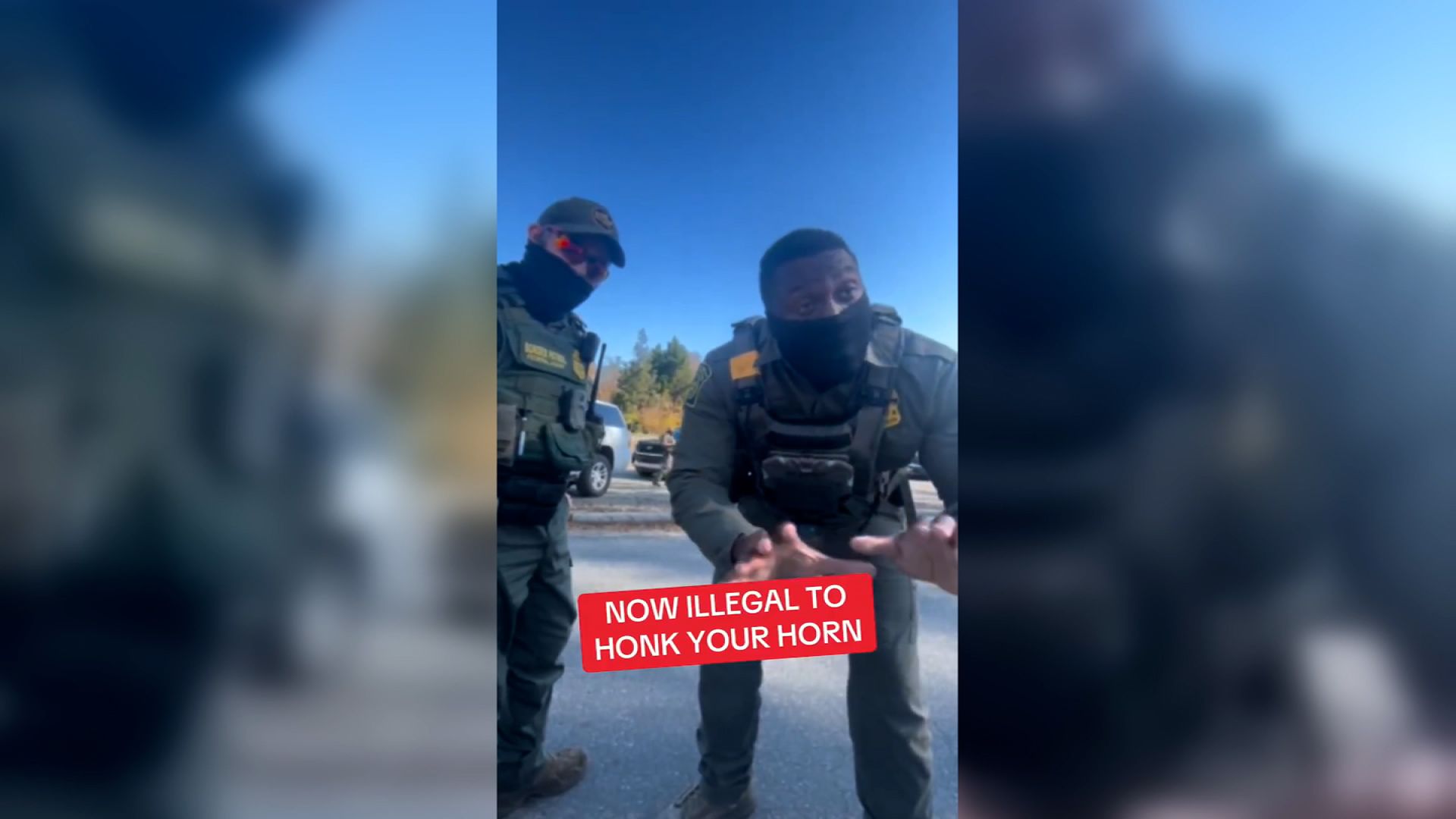

In November, agents pulled over a professor who had followed them in a car in Carpinteria, California, cell phone video shows. “It is a federal crime for you to be interfering with us,” an officer told the man.
“How am I interfering?” the professor asked. “I haven’t honked my horn… what am I doing illegally?”
“18 USC 111!” the officer shouted as he went back into his car.


In Ecklund’s case, officers approached his car and warned him not to follow them after he had tailed them for about five minutes, he said. “I can follow you wherever I want,” Ecklund responded, according to cell phone videos he recorded and provided to CNN.
He continued to follow the officers, and about two minutes later, they stopped again, parking in front of and behind his car. They pulled him out of his car, telling him, “You’re breaking a lot of laws,” the videos show. “I’m allowed to record you in public,” Ecklund insisted as he was detained.
Ecklund was handcuffed and taken to the Whipple building. After about nine hours in detention – during which eight other American citizens were also kept in the same cell – Ecklund was released without charges, he said.

Cases like Ecklund’s show that the Trump administration is interpreting the law extremely broadly, with worrying implications for free speech and protest rights, experts said.
“Threatening people with prosecution because you don’t like what they’re doing is a classic case of intimidation,” said Alicia Granse, a staff attorney at the American Civil Liberties Union of Minnesota. “I don’t think this is really about immigration enforcement, it’s about coercing the state of Minnesota and Minnesotans to fall in line.”
Ecklund said he thought federal agents were using the statute as “an excuse” to violate the rights of protesters and observers.
“It seems like a wildly overblown response to what they’re actually supposed to be doing here,” Ecklund said. “I am not a hardened criminal. I am not a drug cartel member. I’m a local real estate agent who was following them in my car.”
CNN’s Lizzie Jury, Lindsey Knight and Rob Kuznia contributed reporting.
HOW WE REPORTED THIS STORY: To document the number of federal prosecutions filed under 18 USC 111 in recent years, CNN searched for cases on the court data platform CourtLink. It’s possible that some cases could be missing because of variations in the description of the charges in court records. Duplicates in which the same defendants had separate cases before a magistrate judge and a district judge were removed.